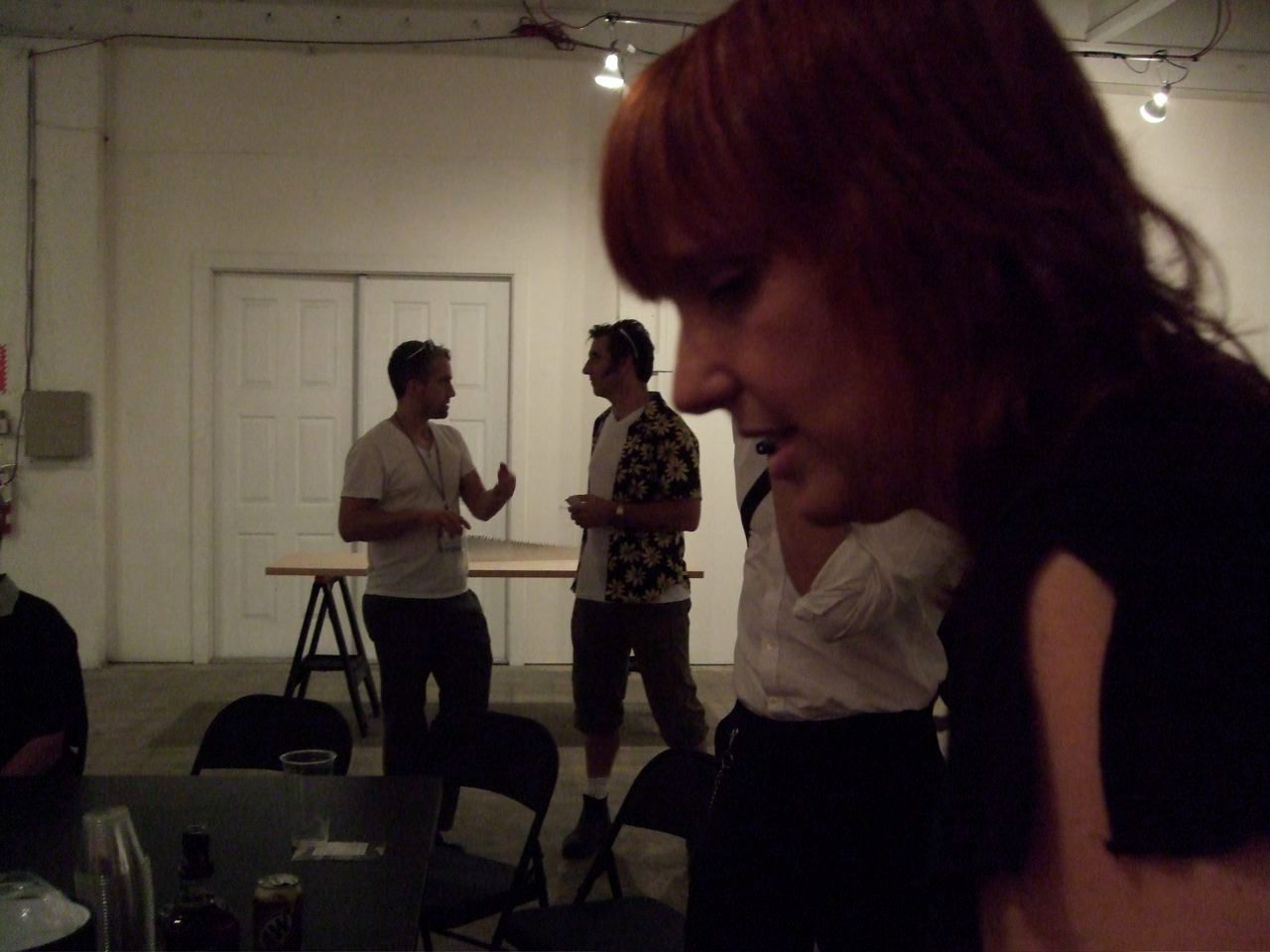
[caption id=“attachment_1363” align=“aligncenter” width=“819” caption=“Nic Rad performing “Bringing My Talents to South Beach””]
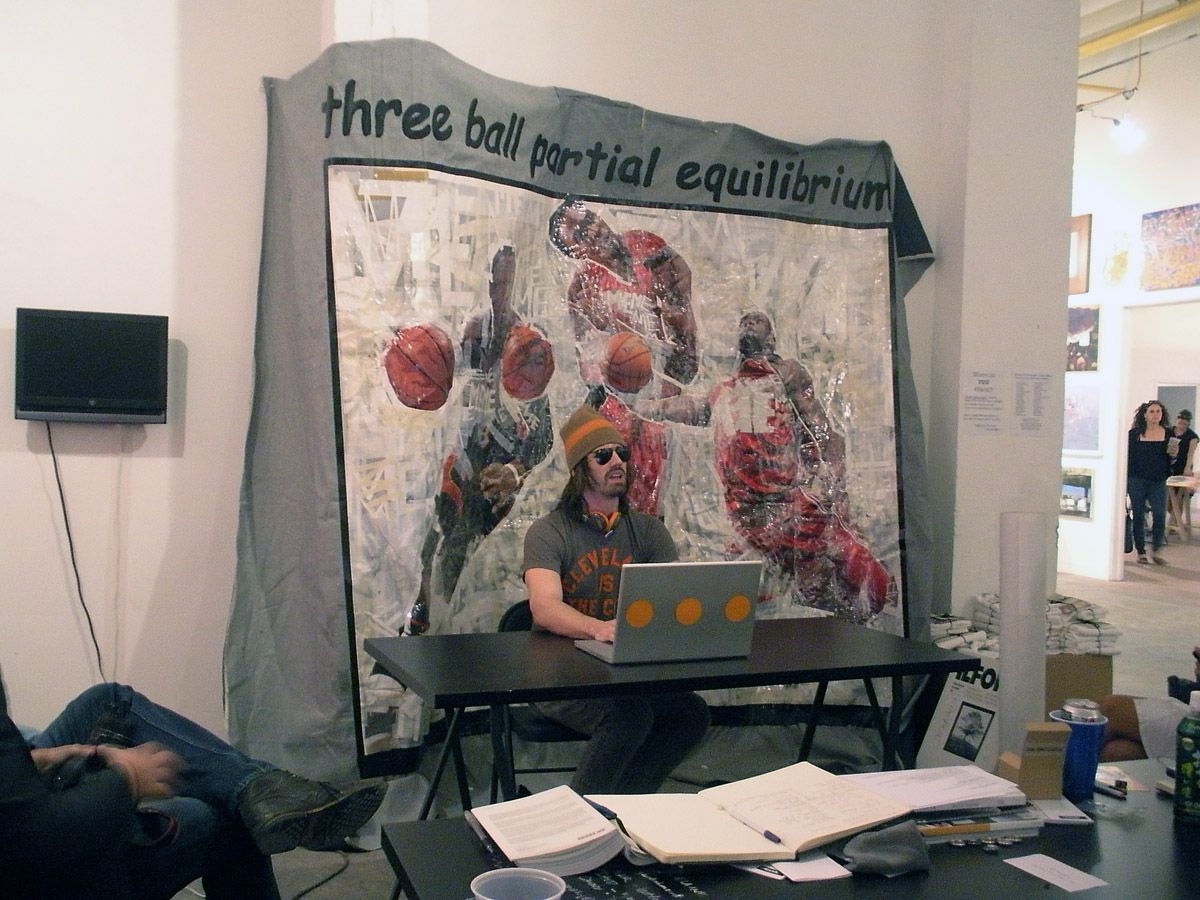
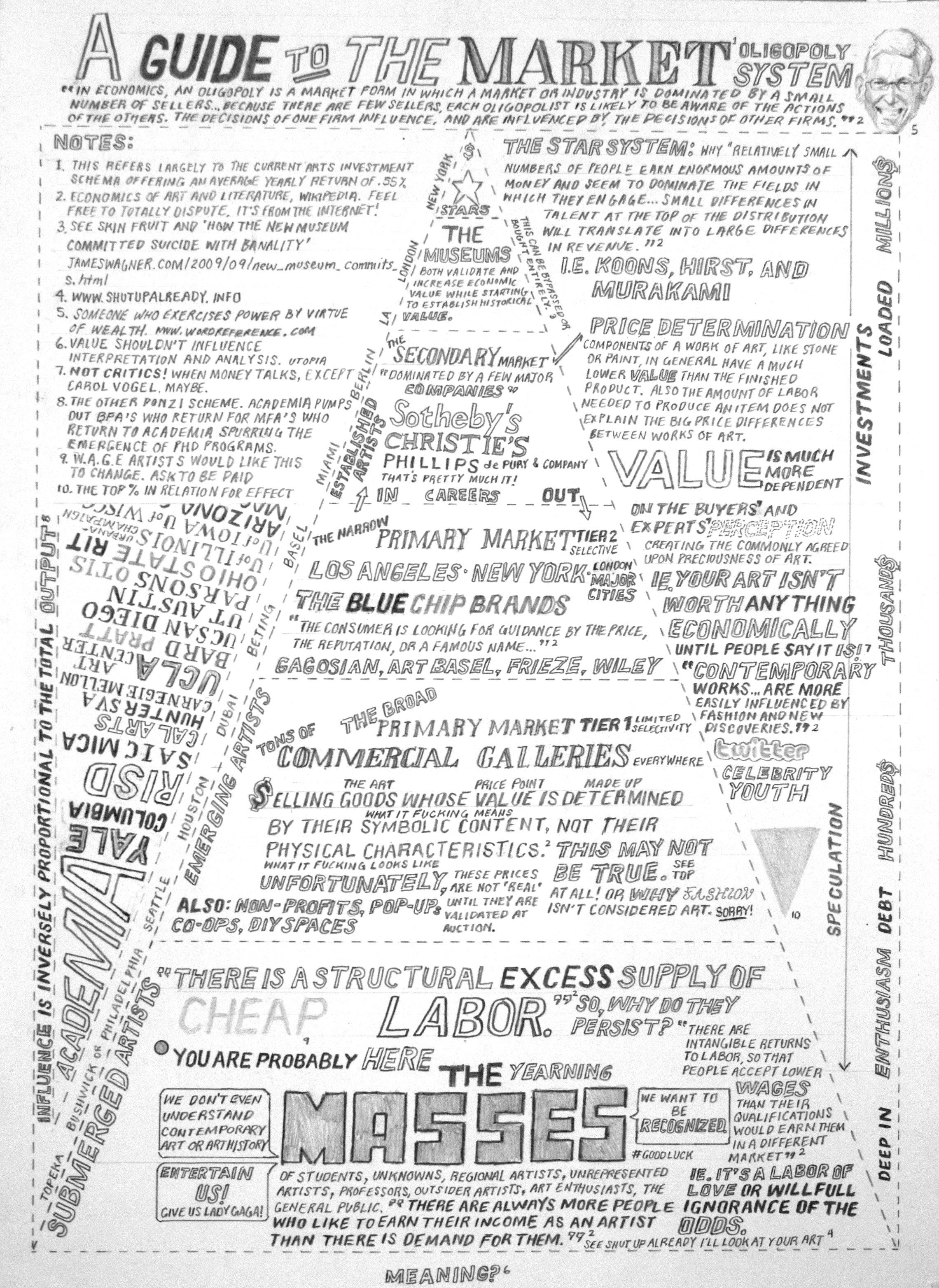
[/caption] Now that I’ve given myself and Jen Dalton a critique about how we shaped #rank, I want to turn the discussion away from the structure towards what actually happened. I’m going to work through the events based purely on my subjective recollection of the events regardless of chronology. It’s my personal form of ranking the events, but this is not a critique of the works in any formal sense. It’s how I experienced them in the context of my previous post and what they meant to me as both organizer and a participant. It should be also noted that I usually started drinking beers around 2pm. The event that I am still thinking about right now is Greg Allen’s lecture on the gala as art. The presentation was like a roller-coaster ride of visceral reactions for me as the subject is also of special interest for me, and has been the subject of several works including ABMB Hooverville and Institutional Celebration. What made Greg’s lecture so delightful and infuriating was the casual way he expressed his familiarity with the art world’s gala culture of self-congratulation. He delivered his lecture with a knowing smile, pausing at times to simply let the audience take in the absurdity of the images like Marina Abramovic having her Oscar moment at the closing of The Artist is Present or Jeffery Deitch piloting Dakis’s yacht with a shit-eating grin. I got the impression from the way Greg spoke that he has probably been to more art dinners, parties, and of course galas than he would like. Several times during the lecture I couldn’t stifle the “What the fucks?” and “Is that for real?” as Greg gave a brief historical overview of the artworld’s attempts to commodify everything, including performance art, starting with Alan Kaprow’s CBS funded “Happening”, which apparently was a disaster and induced Kaprow to give up on them and move to the west coast to start a new chapter in his career. Greg’s lecture seemed evenly split between the efforts of artists he clearly admires like Rirkrit Tiravanija who he lovingly referred to as a “hippie” and Andrea Fraiser’s interventions into the social practices of the of the museum with those of artists like Abramovic whose recent works have passed into a realm of solipsism so vast that it has actually taken a part of the art world with it. He included silver-leafed, candy lips in his swag bags to reference the gold-leafed chocolate lips that Abramovic presented at her gala closing dinner that were meant to ‘aesthecize her sprirituality’ or some nonsense. Feminists call that ‘fetishizing the body’. Watching the lecture, I couldn’t help but lose whatever respect I had left for an influential performance artist gone the way of the pharaohs. The apparent focus of the lecture, though, was on the gala that Doug Aitken ‘produced’ for MoCA. Greg wanted to provide audio of a clearly disinterested and perhaps annoyed Aitken dismissing Deitch’s salesmanship of the gala as a unifying medium, but it had recently been redacted online. Still, Greg had transcribed the unflattering audio, which he read to the audience. From what I understood, Aitken may have rather brilliantly pulled one over on MoCA and the gala as an art movement by framing the event through the historical divisions among the monied elite in Los Angeles. Where Greg lost me, though, was with his admiration for Jennifer Rubell’s Creation feast in the former DIA space last winter. He seemed to genuinely feel like Rubell had produced the most interesting gala related art piece to date by making the excess of traditional gala visible all at once for the audience. I don’t believe for a second that Rubell’s intentions were to critique the gala, but to be provocative and novel for an audience used to black-tie, celebrity-studded, red carpet affairs. Greg did point out that the Rubell’s made their fortune in the hospitality industry, further confirming by belief that she works without a sense of self-awareness or irony, and is truly sincere about her works. She just happens to be loaded and incredibly privileged making her the perfect vehicle for the work she creates. She is truly a product of the art world elite and the most qualified person to serve them brunch. One of the funniest moments in the lecture, though, was his story about how Naomi Campbell started a riot by snatching up a complete set of Takashi Murakami place mats, egged on by Tom Ford at some gala a few years back. The anecdote revealed the petty carelessness and entitlement of the ruling class. His lecture and slideshow were one of the most unflattering depictions of celebrity and wealth that I have ever witnessed. It was brilliant, and what only increased my respect of Greg was his ability to ignore some of the most distasteful aspects of gala culture and still approach his analysis with nuance. He was able to suss out the art from the excess, marketing, and social inbreeding. Perhaps my inability to be so generous or understanding in my assessment of gala culture is that I am an artist and Greg is not. He is an art lover, which is evident in the way he talks about art, but he doesn’t have to compete with it. For him, it something to digest, to take in, and he can afford to sit back and mock what he finds distasteful and talk about what he admires. I loved the way he would dismissively say “he’s a great guy,” about art world superstars as he walked the edge of the high road, never careening down the side to the road I travel on through the art world. Greg’s lecture and slideshow is marvelous and covers much more than I am describing here. It will be available online in the coming weeks and I urge everyone who has ever felt a wave of nausea upon seeing a picture of Guilty Pleasure or after spending too much time on the Artforum Diary (where Greg noted he got many of his dyptichs of people smiling so hard their faces look like they are about to break in half). As a part of #rank, it was one of the most relevant events to our thesis, speaking directly about the top tier of the art world so busy celebrating its own achievements, it often fails to notice how fucking grotesque and insular it might appear to the people it purports to offer culture. If I had to give any other justification for why this event is so clearly etched in my mind, it ruined the rest of the day for me. I couldn’t stop thinking about Abramovic perched up high like some sort of goddess, aestheticizing her ‘spirituality’. Right. What I learned is is that not much has changed since F. Scott Fitzgerald made fun of rich people. They are still careless with their wealth and power. The next thing I can’t scrape out of my thoughts was Nic Rad’s bravura reading of “Taking My Talents to South Beach”, a scathing critique of social mobility as told through the perspective of Jeff Koon’s sculpture “Three Ball Total Equalibrium” if the basketballs were played by by Dwayne Wade, Chris Bosh, and a bizarre hybrid of LeBron James and Nic himself. It was a sort of brilliant over-identification on Nic’s part based on a shared home (Cleveland), privilege, and personal ambition. I can’t even begin to recap the narrative, but it bounced between pop culture, high-art, artistic ambition, failure, class and racial divisions, hip-hop, masculinity, and homophobia and a host of other paradoxes. Nic matched the narrative acrobatics with his vocal performance, switching between the nasal, vaguely british accent that only very rich people have (think Mary Lou Whitney here) to the locker room slang of superstar atheletes back to his own speaking voice. There may have been more, but I was lulled in and out of my reverie by the abrupt changes in cadence. By the end of the performance Nic had managed to dissolve the artificial barriers between art and society by following the intertwined threads of money, power, and ego. It was a brutal assessment, and Nic gamely took shots at everyone, including myself and Jen Dalton. “Should I adapt an alter ego and hang out in Bushwick until someone includes me a more self loathing kind of ready made installation and then revel in a late career Bill Murray sort of revival where a monotone sadness does penance for the preposterousness of my youth? " I could feel that one whistling past my ear. In my drawing “A Guide to the Market Oligopoly System” I depict the way the art market supports a handful of superstars, and by linking art to professional basketball Nic blurred the fuck out of any lines between Jeff Koons and LeBron James. What it made apparent is that if Jeff Koons is LeBron James, then Jen, Nic, and I are playing ballball for the Aliaga Petkim in the Turkish Basketball league (otherwise known as SEVEN). Nic’s performance distilled some serious class and cultural rage into a very strange and disarming reading. This is also one of the events where I really wished we had time to discuss what he did. It was packed with puns and word games as Nic batted art speak, locker room slang, and poetry around. I hope we get a chance to sit down with Nic at our upcoming #rank rehash and talk about what he dropped on the audience like a Blake Griffin dunk over a slow-footed 7-1 Russian whose name nobody will remember. Truff. During the first full day of #rank performance artist Rebecca Goyette was walking around SEVEN in a red dress wearing lobster claws giving out hugs. Rebecca is a street performer as well, and has done similar public performances. Apparently, the dealers as SEVEN were extremely uncomfortable with Rebecca’s curious presence because she was not constrained to our petting zoo. Rebecca moved through the fair with her bizarre outfit making a whole lot of people really uncomfortable. I believe that was the primary purpose of the performance, although Rebecca said she would be wearing her ‘most professional attire’ during the hug performance she described to us. I think she was being sarcastic in retrospect, but ultimately, by the end of the first day of #rank we were informed that Rebecca could not continue the performance for a few hours on Friday as we had initially agreed upon. Down the path of censorship we go, Down the path of misinterpretation we go, unfortunately it was left to Jen to break the news. I would have done it, but apparently I was in the bar drinking beers or something. Jen talked with Rebecca and asked if she was satisfied with having one full day at #rank, which is the longest anyone had for any project besides Mandie’s (that project is going to require a separate chapter) and other stationary take-aways. Rebecca indicated that it was cool with her, but really it wasn’t. She was upset that she was not welcomed by SEVEN and probably felt like we weren’t supporting her project.** If I or Jen had known she was upset, we would have said “fuck you,” to the powers that be and kept Rebecca with us in the petting zoo area on Thursday if her presence made the art dealers too uncomfortable, which it did.** She was wearing lobster claws with fake boobs. It was quite an outfit. Still, we didn’t know and unfortunately, Rebecca mistook Jen’s stressed-out, frazzled delivery as rudeness. Jen is not rude, she is direct and candid, but never rude. I feel terrible that we shut down Rebecca because of miscommunication, but in the end, her original performance was only scheduled for one hour, and we managed to have her present and freaking out the squares for 8 hours. Anyway, Rebecca, we are sorry if it seemed like we weren’t standing up for your project. #rank was supposed to be about being different, not being square. It was about lobster claws and tension. Rebecca hit the ball out of the park in that regard. (*note: Whatever Rebecca’s feelings, I’ve outlined our correspondence regarding the issue here, and that based on what we were told and what she presented, I feel that Rebecca was given exactly the amount of time agreed up initially, and she made it clear to Jen that she was satisfied with that duration and that Friday was not necessary. We didn’t ask her to change her outfit during the performance based on her initial proposal or keep her confined to the #rank space.) One of the other tense parts of #rank began when Emily Auchincloss made her assertion near the end of her lecture on Post-Traumatic Art Disorder (PTAD) that relativism is not okay. She argued passionately that there are fundamental truths that are right, no matter what your cultural background may be, and some truths are more important than others. That is at once a radical and radically naive belief, and a brave assertion to make in light of the continuing debate over the removal of David Wjonarowicz’s A Fire in My Belly (3) from the NPG by a Smithsonian Secretary bowing to pressure from the Catholic League(1). This is a group that believes there should be NO public funding for art, ie that the NPG should not exist in the first place, not just show what is agreeable to sensitive Catholics. This is important beyond the clear case of censorship, because in effect, it highlights my disagreement with Emily’s thesis. I don’t believe in God. Therefore, the entire basis for the Catholic’s argument is a metaphysical fallacy in my book, and my respect for the religious community stems more from the support and services it provides to people, not its relation to truth. An important function of #class was to simply discuss the terms of critiquing the art world and its institutions like academia and the market. During Emily’s lecture and the ensuing critic’s panel, we barely had time to engage in a discussion about relativism and essentialism. Truth. It’s a subject humanity has been grappling with for a long time. For me, there are things we know about the physical world through mathematics and science that can be falsified. There is demonstrable evidence that the assertions can be proven false. You can’t disprove the existence of God, therefore it is a concept that is not falsifiable. It is a matter of faith that gains power and acceptance through common agreement by people that there is a all-mighty, omnipresent entity. Many people believe that Sara Palin should run for President. They will say that what she says speaks common-sense truth. There are also people who believe that color has a spiritual component. I spent my time leading up to the opening of #rank making absurd generalizations about truth on my twitter feed. People reacted in very different ways tostatements like, _all artists deserve to be recognized. _It is a statement of opinion. Most, if not all art, is a matter of opinion from what it means to how it is valued. I can tell you that Jeff Koon’s work is valued in the millions. Is it true? In the market it is priced that way and it bought and sold. The statement works, but there is no essential value for Koons’ work. It is only the agreement between opinion of the buyer and seller that makes the statement work. At auction, we see prices being set based on the opinions of the buyers competing to assert the highest possible value. What makes Koons’ work valuable in the most obvious, quantifiable terms is the opinion of the person with the most money. If it was based on my opinion, the work would be worth about what it cost to fabricate it, so that the workers could get paid for their labor. I don’t think Koons deserves a penny. What I am getting at here is that the value of Koons’ work is relative to changing opinions, and that what we think is true, is generally based on a majority opinion or a minority opinion backed by a lot of wealth. So, we weren’t able to debate structuralist thought with Emily, and the critics at the panel seemed a little flabbergasted by her assertion. I don’t think they knew what to make of the statement, like she was articulating some radical new philosophy coming out of France. By the time they realized she was just expressing her own opinion about essentialism, the discussion was over. What they did talk about though, was how relative their own opinions about art are based on their interests in different genres. Paddy Johnson argued that she writes best about new media art, because she that is her area of expertise making her analysis of new media works stronger than that of other genres. Hrag Vartanian talked about critics having ‘beats’ or areas of interest that they cover with special interest. Hrag writes extensively about social media art and street art. This is very different from the the Greenbergian model, where the critic’s opinion defines the hierarchy of what art is important based on what they write about. For Greenberg, the most important art was painting, and that opinion persists in the art world for a number of very practical reasons, but also Greenberg’s powerful influence in defining ’truth’ about Modern art, most of which has been discredited as essentialist reductionism and metaphysical quackery. Emily’s frustration with art criticism though also has to do with the bleeding of opaque, theoretical, academic discourse into the public practice of art criticism. She identified some important points about reforming the practice of writing about art for both a general audience. Basically, she would like art writing to be clear and direct, passionate, connected to the world, open to interpretation, and finally, humorous. I’ve been ranting about Matt Taibbi’s book _Griftopia, _precisely because Taibbi is doing all of these things about the economy and politics. If we was writing about art, he would be my hero. In fact, in support and contradiction of Emily’s belief in truth I will quote Matt on the mumbo jumbo that is Ayn Rand’s Objectivism
This belief in “objective reality” is what gives objectivists their characteristic dickish attitude: since they don’t really believe that facts look different from different points of view, they don’t feel the need to question themselves or look at things through the eyes of others. Since being in tune with how things look to other people is a big part of that magical unspoken connection many people share called a sense of humor. the “metaphysics” of objectivism go a long way toward explaining why there has never in history been a funny objectivist. -Matt Taibbi, Griftopia page 41.(2)
The purpose of the above quote is that in the end, Emily is grappling with a paradox. She wants definite, absolute meaning and she wants the humor and ambiguity that come from multiple perspectives. It is possible to agree that things have more likely meanings in relation to the universe than others, but by the time we observe pretty much everything, we have fundamentally altered it in the act. Shit happens, things change. The world isn’t flat, the sun doesn’t revolve around us, and we don’t breath ether. Taibbi is basically arguing that people who have empathy for others can laugh and cry with them, when they look past their own fucking concerns. It’s not a radical concept, but hanging around with Tea Party members convinced Taibbi that he needed to write a book about how Objectivism and other solopsistic quasi-philosophies have fundamentally fucked most people’s ability to empathize up to the point where they believe Sara Palin is right. I am hopeful that Emily will recognize the paradoxes present in her desire to find meaning in the world. I’m not going to stand around waiting for the truth to come down from the Mount or a critic’s pen. I’m going to engage in some productive persuasion, or what Emily Falvey called “bullshitting”. I’m fine with that. I just want to be more right than some asshole I disagree with. While Helen Allen is definitely not an asshole I totally disagree with, I felt like her presence at #rank was all the evidence that we needed that something is wrong with the big box art fair model. In fact, Helen was the founder and director of PULSE until this spring when she resigned. When I asked her why she walked away from the fair she created she simply said. “I didn’t own it.” Helen is an incredibly diplomatic advocate for art fairs as both a business and exhibition model, but her statement about PULSE reveals a great deal without saying anything. One, it says that she was not in control of the direction of the fair. She couldn’t execute her directorial vision because she did not have the final say, the owner did. It also suggests that there was something wrong with the direction that fair was going, some of which we touched up in her discussion. So, instead of continuing to fight to retain her original vision of PULSE, she left and has started a new model for the art fair called (E)MERGE based in Washington, DC. The new fair will be different, focusing on non-profits, unrepresented artists, and commercial galleries with a strong educational component. Helen talked about artists giving lectures about their work during shuttles from New York to Washington. This is not business as usual, and Helen is using all of her experience and passion to re-focus collectors on what matters; the art and what it means, not how much it costs. I think this in an incredibly admirable market-based solution to making the art fair more than a trade show. I think this is exactly the kind of solution that Jen and I were hoping would come up at #rank in relation to the art fair context. Helen is trying to create a smarter consumer who can trust their own opinions and judgments and not lean so heavily on reputation and auction returns. Still I can’t let Helen or myself walk away from this discussion without mentioning some of the things that were disagreeable with PULSE and the current model of the fair, and why SEVEN was even happening as well. After I participated in PULSE last year in Miami I was very critical of Schroeder Romero’s decision to re-hang the booth after work had sold. Michael Waugh’s excellent drawing was taken down and replaced after it sold quickly. As an artist, this was a slap in the face, since we want our work to be seen by curators, critics, museum directors, and a broader audience than the one person with enough cash to buy it. I understood the gallery was under immense financial pressure to do well, and I can’t fault them for trying to sell art, but it came with at a cost; the visibility for Michael’s work. (note: Sara Jo Romero reminded me that they did replace the large work with another smaller drawing and a print diptych by Michael. I understand other work was seen by many visitors, but an artist I know I want my best work to be seen, especially when so much time has been invested. I also don’t want to single out Schroeder Romero, they didn’t invent this practice and I know that they would have loved to keep the large drawing up for the duration of the fair. I’m trying to highlight the way the expense of the fairs favor commerce over curation. It’s not a simple issue and I am speaking as an artist.) I think that the practice of swapping out work is fairly endemic, and Helen agreed that it was a concern at PULSE. She noted that there was often a discrepancy between what projects the galleries proposed and what ended up in the booths during the course of the fair. In order to succeed commerce often trumped curatorial excellence and visibility of work. An art fair can be more than commerce. They can make important connections, and this year my work was seen by a museum director from Scottsdale and we are talking next week about a show she is curating. To develop a lasting career as an artist, it is about developing connections with institutions that can bring the work to a broader public audience than art collectors. I believe Helen understands this, and that is one of the reasons she left PULSE to pursue a different vision of the art fair than just as a trade show. It was excellent to have Helen as a guest at #rank, and she was a great ambassador for the art fairs. She spent a lot of time arguing for the democratic possibilities the art fair model offers by bringing together so much art in one place, that it allows people to see art they ordinarily might have to travel internationally to see in person. We talked about how they allow galleries to make sales that support their brick and mortar spaces, artists, and keep them in business. The downside is that they are incredibly expensive to run and participate in leading to less risk-taking and more contingency. While we all agreed that models like Volta allow for a singular vision and more curatorial control, they are also a much greater risk for the gallery. If the artist does not go over commercially, there is nothing to swap out, nothing else to recoup costs with. So the fairs are a gamble that galleries try to offset with different contingency strategies from blue-chip galleries showing secondary market work along side emerging stars to smaller galleries programming salons in their booths. The problem here is that market pressures can lead to some unfortunate inbreeding, where dealers spot an artist whose work is selling out of gallery in another city, take them on and show them, but return to the next iteration of the fair and suddenly there are three galleries showing the same artists. I am an example of this myself. Charlie James found my work at PULSE and now shows at PULSE as well. This can lead to a kind of a homogeneity that is bad for art, a formulaic approach to selling art that doesn’t reflect the broader, less commercially viable practices that also exist in the art world. This is one of the reasons I am not content to make drawings for the art fairs and gallery exhibitions. #rank is also part of my practice; critical self-examination of what it means to participate in the market. Anyway, I really appreciated Helen’s presence at #rank, but unfortunately, the hour flew by and we weren’t really able to take the gloves off and really engage all of the problems/solutions that the art fair model poses. I would like to have talked about the tensions and irony of participating in an alternative art fair setting populated by several galleries that previously had shown in PULSE. I don’t recall if any of them were present at the table, but I would’ve loved to have heard Ed’s thoughts about SEVEN versus PULSE. Till next time I suppose. Helen has an open invitation to come to our #rank rehash or any #class related events in the future. She is one of the most ardent supporters of art and artists’ visions I have met in the commercial art world. Apparently, this reflection process is going to take a lot longer than I thought, and since there is no overarching arguement I am trying to make, I am going to publish it in sections. I’ve only touched upon six of the events, and there is much more to be discussed. To be continued… Footnotes: 1 Please read Tyler Green’s excellent coverage of the Wjonarovicz debate on his blog Modern Art Notes. 2 Buy Matt Taibbi’s Griftopia right now. The link goes to Amazon, I don’t care how you buy it, just get it. 3 PPOW Gallery has generously made the 4 minute version available on Vimeo.