[caption id=“attachment_1237” align=“aligncenter” width=“642”]
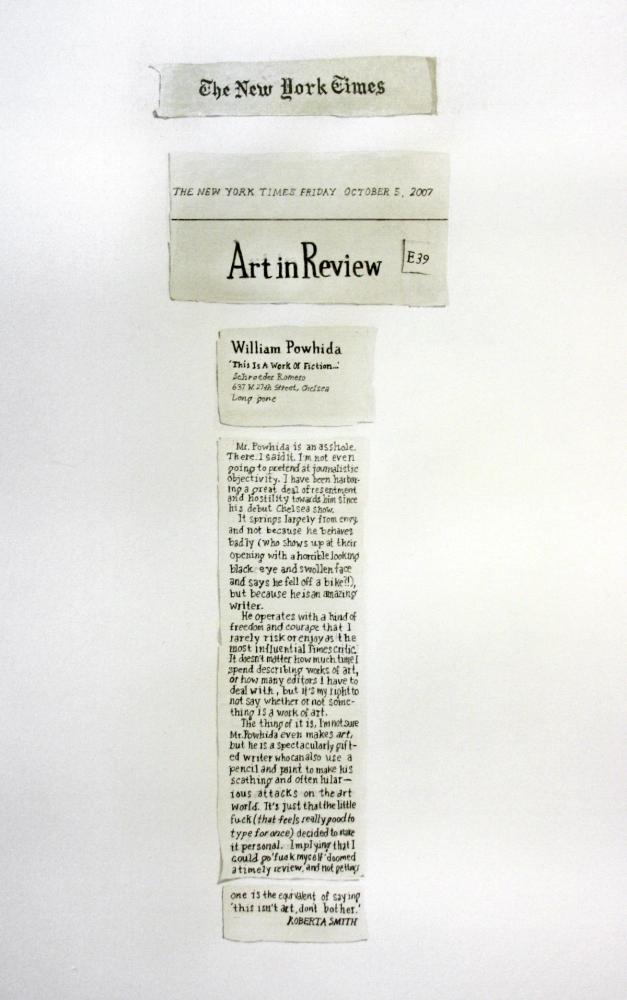
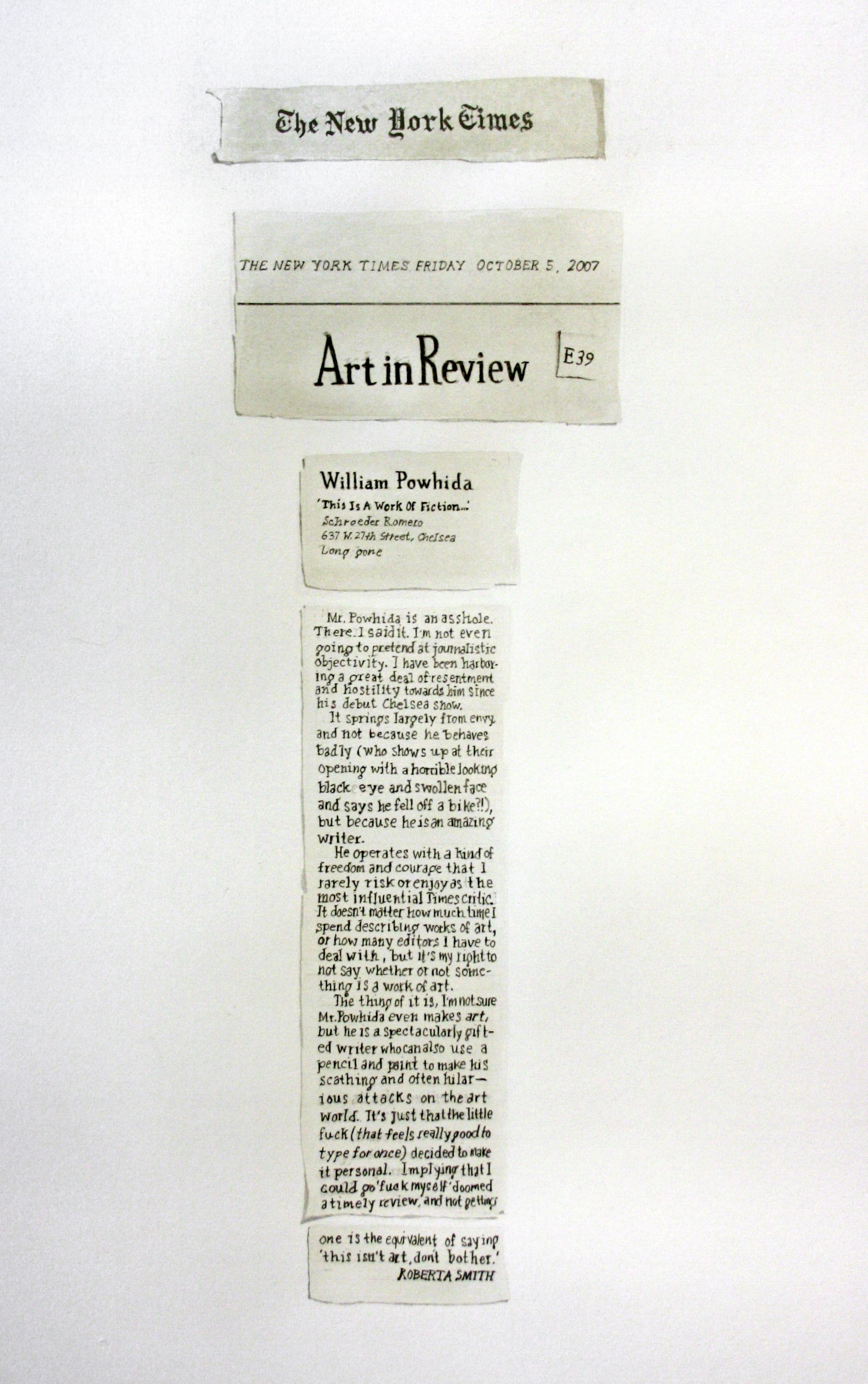
11" x 14", Watercolor and graphite on paper, 2007. Courtesy of the artist.[/caption] A few weeks ago my friend Ryan Schneider and I were in Chelsea for the closing of _The Big Picture _at Priska Juschka. Ryan and Tom Sanford had curated the show of very large paintings from a group of painters who all embrace some aspect of the expressionist tradition. Well, not all. One female artist in the group painted much closer Tom’s comic realism than say, I don’t know, anything else in the show. (Apologies to Tom and Ryan, I early posted there was only one woman in the show. Actually, Liz Marcus, Holly Coulis, Emily Lambert, Colleen Asper and Lisa Sanditz had paintings in the show).While I respect Ryan and Tom, our tastes in painting tend to diverge from a shared sense of the absurd and bear little resemblance after that. Overall, I thought it was an interesting show. When Ryan told me that a New York Times fact checker had called the gallery, the show was all but certain to get a coveted Roberta Smith Friday Times review. Then, a funny and familiar thing happened. The review never ran. Maybe Ryan, Tom, and the gallery shouldn’t have asked for the review to be pushed back into September even if the show would closed during August. I mean, the point of a review isn’t really to drive foot traffic. It’s to legitimize the prices of work and give explicit permission to collectors to drop some cash. Ryan was pretty much crushed, and to add insult to injury, the Times ran that lovely ode to Gagosian and Dan Colen on the front page the day the review never ran. While, I’m not arguing that the Big Picture show should or should not have gotten a Times review (These guys are my friends), it was at some point in the pipe line for publication. Back in 2007, when I had my first solo show with Schroeder Romero, Holland Cotter dropped by on the last day of the show and while leafing through the press for the show said “I thought we covered this,” as he flipped through the book, clearly not seeing a NY Times review. Now, I have no idea who, if anyone, was actually going to write about the show, but I decided it had to have been Roberta. Why? In a small drawing in the show titled “What Not To Do” one of the directives was “Tell Jerry and Roberta to fuck off.” I like to believe that killed the review, somehow. To that end, I decided to write the review anyway. I’ve been thinking about this drawing since Ryan was nearly crushed by great expectations, and my friend @artlthr sent me this link to Dave Muller’s drawing “Smith” and “Re-Smith”. It made me feel old, but also vaguely justified in doing this in 2007. Nope, I don’t feel old and apparently Dave Muller was doing his Times review pieces decades ago. Way before I ever thought about it. Image: Art in Review, 11" x 14", Watercolor and graphite on paper, 2007. Courtesy of the artist.
Emily Falvey’s excellent
essay
that discusses my work. This text was first published in the Montreal contemporary art magazine esse arts + opinions, No. 69 Bling-Bling (Spring/Summer 2010).
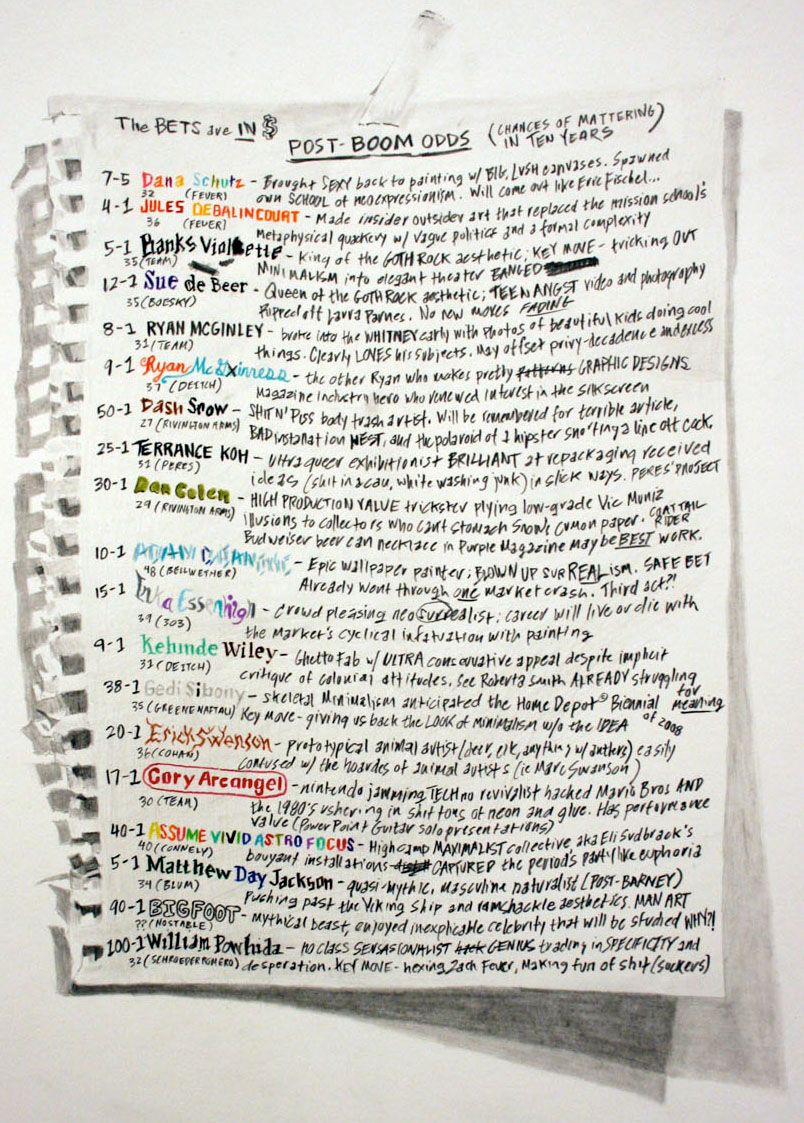
Image: Odds*, Graphite, colored pencil, and watercolor on paper. Courtesy of the artist and Artist of the Month Club. 2008. *#dancolenfail
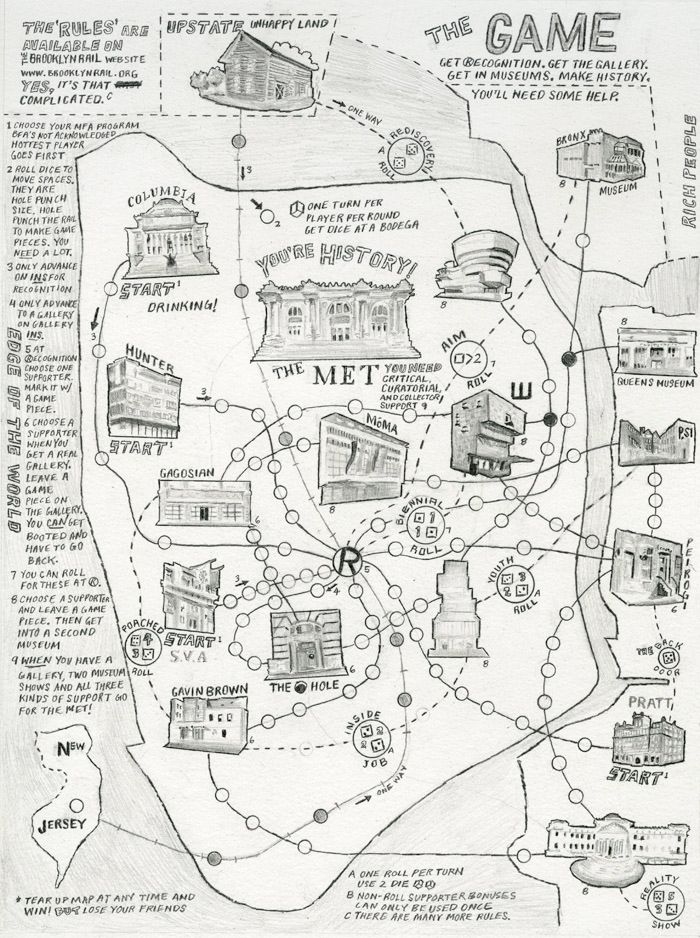
The goal of the game is relatively simple, get your work in to Met and make history.You need to follow a path through the art world from an MFA program towards recognition, representation, and museum exhibitions while picking up some supporters along the way who will help propel you into history.Like the real art world, whether your in or out is largely out of your control.We’ll assume you have some modest talent, but making history requires a lot of luck.The only decisions you have to make along the way are which paths to try to get ahead, whether or not to drink, and how you can best use your supporters influence to advance your career, the rest is either luck or chance, depending on your outlook on life. You can also play the ‘Bitter Version’ by following the suggestions for modifying the game play. Also, feel free to make your own supporters and new INS and OUTS. There’s at least 197 other collectors who matter and shit loads of ins and outs. Good luck.
The Game Play
- Determining the order of the players:
- Hottest player at the table selects their MFA program first
- Youngest player selects second
- Richest player selects third
- Meh. You’re in the game, loser.
- On the way to ®ecognition:
- Each player gets one per turn round.
- Advance your circle forward to the first circle on the path to representation. Roll one or two die to see whether your IN or OUT.You will either go forward, backward, lose turns, or in some cases, end up in New Jersey teaching.
- Note: Whoever starts at Pratt can take one “backdoor” roll before they leave the relative safety of grad school.
- Getting ®ecognition:
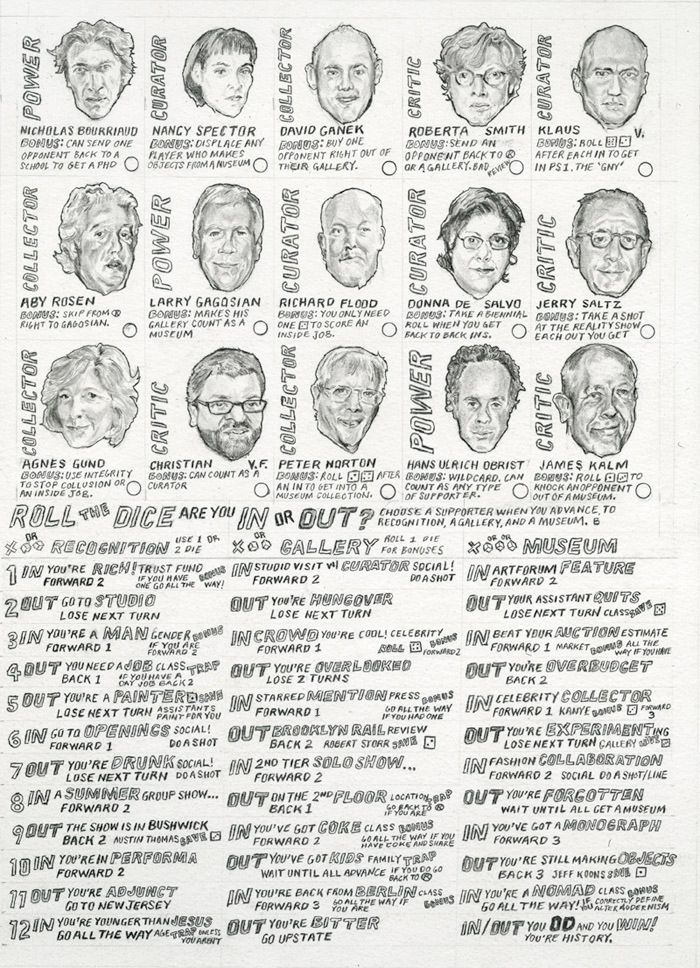
- The first player who advances to ‘®ecognition’ can roll 2 dice (or the sum of 3 single roles) to determine who their first supporter will be.You can roll for a CRITIC at this early stage of your ‘career’.You might get lucky and get a power card, but not all of them are that helpful.In fact, you might have to make a deal later on or get into a third museum.
- CRITIC Values:
1.Roberta Smith = 3, 5
2.Jerry Saltz = 4, 10, 7
3.Christian Viveros-Faune = 6, 11
4.James Kalm = 12, 8
5.Power Card: Hans Ulrich Obrist = 2
- AIM Program and Biennial Rolls: You can choose one shortcut roll to make when you reach ®ecognition, but not if you get sent back.
- NOTE: You can only call upon discretionary powers once per Game and you may use them immediately after determining your first supporter.Follow instructions for roll based bonuses.James Kalm’s power may be used each time another player gets into a museum, including the Met.
- From ‘®ecognition’ you need to choose a gallery to advance towards.Unlike real life, you cannot lose your recognition but outs can send you all the way back to the ® circle.If you want to play the “Bitter Version”, outs can send a player all the way back to the steps of their graduate schools.In real life it usually happens when you buddy up with a professor who does you a favor and gets you a job.
- Getting a Gallery: If the supporter is already occupied you can BEG the player to let you share the supporter or take the supporter with the closest numerical value.
- If you ever advance to a gallery, roll for your new supporter
i.COLLECTOR Values:
1.David Ganek = 2, 5
2.Aby Rosen = 3, 6, 9
3.Agnes Gund = 4, 7, 10
4.Peter Norton8, 12
5.Power Card: Larry Gagosian=11
- If you have gotten to Gavin Brown’s Enterprise you may make ONE poached roll when you arrive.If you get a 3 and a 4 you may advance to Gagosian Gallery.You may stay at Gavin Brown and take on Inside Job roll per turn if you’re a scumbag, but nobody will judge you I’m sure.
- Getting a Museum:
- If you somehow manage to advance to a museum before you pass out from doing shots, chugging beers, or doing lines off your iPhone, you may select your third supporter, a curator.
i.CURATOR Values:
1.Nancy Spector = 3, 5
2.Klaus Von Biesenbach = 4, 9
3.Richard Flood = 7, 11
4.Donna De Salvo = 10, 12
5.Power Card: Nicholas Bourriaud (BORE•ee•oh) = 2
- Getting into a second museum:
- It should be relatively easy to get into a second museum now that you’re an art star, or you decided to conquer the outer boroughs.You may indeed now roll for another supporter of your choosing.You have some power.
- NOTE: If you want to play the ‘bitter version’, you may continue to take over museums before anyone else can get to them and effectively win the game that way without ever getting into the Met.
- Getting into the Met:
- So you’ve done everything you’re supposed to do, right?You have recognition (or skipped it!), a gallery, at least two museums, and a critic, a collector, and a curator behind you, BUT there is no PATH to the Met.How do you get in and make history?I have no fucking idea.It’s really, really hard.In fact, you, the players, need to figure that out. Here’s a couple of suggestions.
i.Take a vote! Use a secret ballot andwrite IN or OUT on a little piece of Rail and throw them in a hat or something to determine if the player is worthy of making history.Hopefully, you have been nice to your fellow players and not belittled their futile attempts at negotiating the art world.
ii.Determine your own Auction Value by calling the value of a roll.You have a 1 in 6 shot of getting it right.You can try once per round.
iii.Fuck it, no one can stop you.You’ve won.Argue like hell with the other players that it’s the only fair way to end the game. Try and convince them the art world is really a fair, balanced, and reasonable place.
iv.Bribery.Divide up whatever cash you have and give it to the other players.
v.‘Bitter Version’ Don’t do anything.You’ll never know if you make history, because you’ll be dead.
Get a hole punch and make a bunch of little circles by punching holes in the Brooklyn Rail.Start with the Art Seen Section.You’ll need about twenty to play the game. Hopefully, you counted the number of steps you will have to take from each MFA program. James Kalm’s power may be used each time another player gets into a museum, including the Met. Image: The Game, graphite on paper, 2010. Courtesy of the artist The Brooklyn Rail